
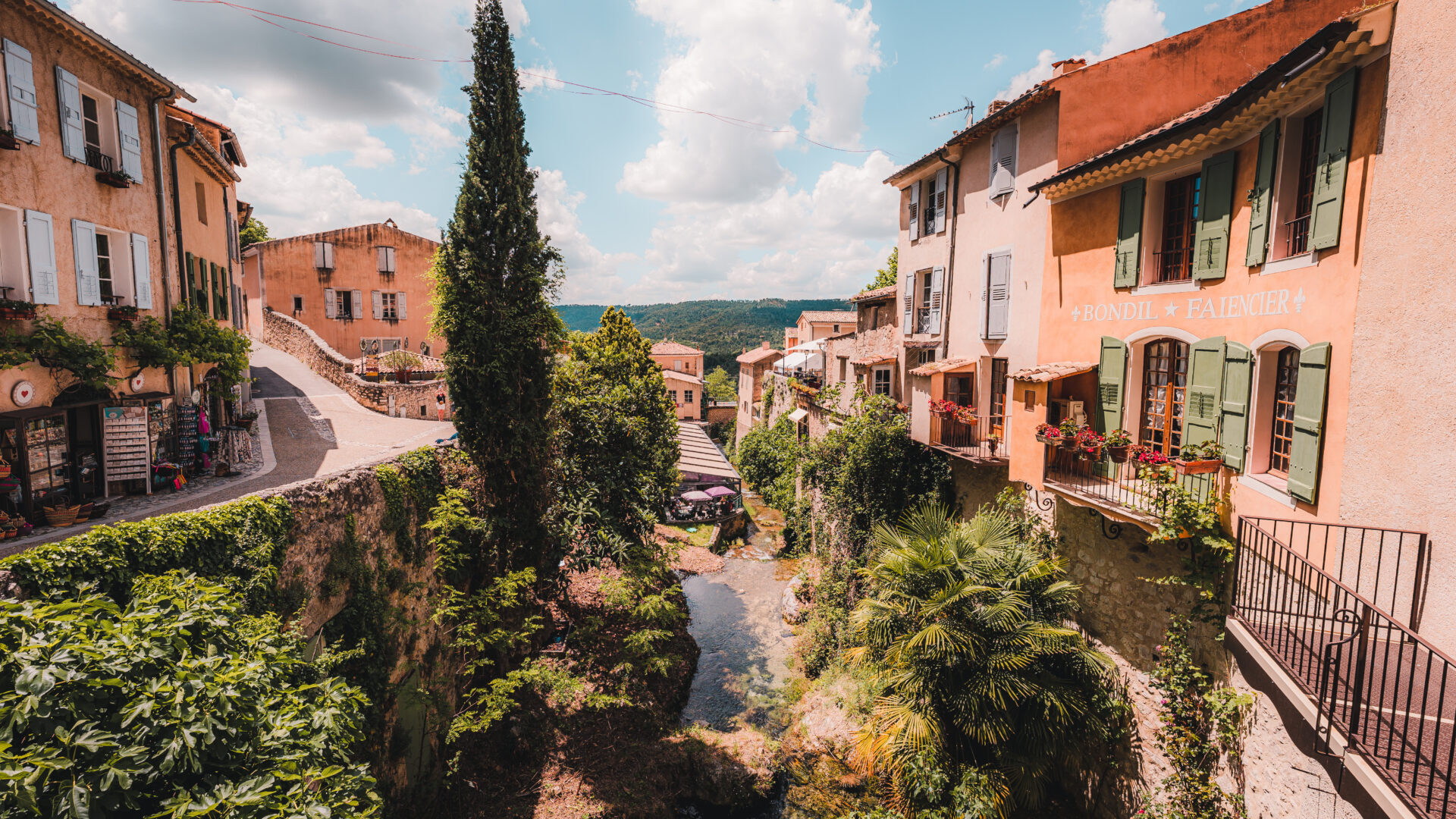
Heritage trail of Moustiers
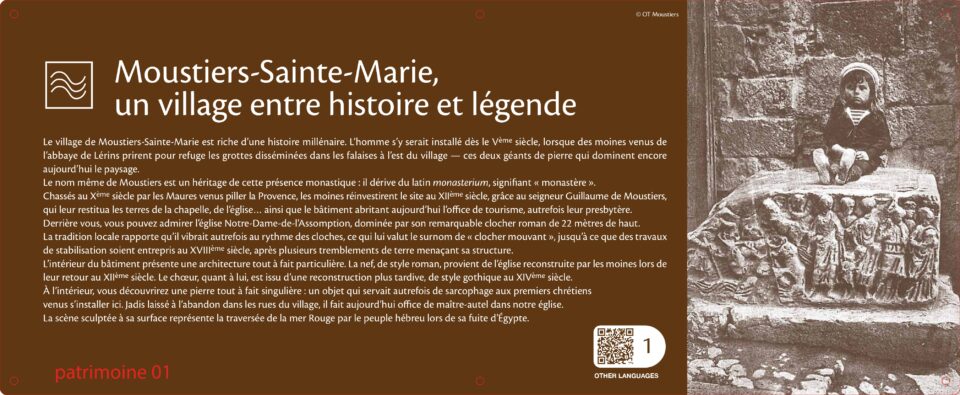
Moustiers-Sainte-Marie, a village between history and legend (01)
 © OT Moustiers
The village of Moustiers-Sainte-Marie has a rich history of thousands of years. Man is said to have settled there as early as the fifth century, when monks from the abbey of Lérins took refuge in the caves scattered in the cliffs to the east of the village — these two stone giants that still dominate the landscape today.
The very name of Moustiers is a legacy of this monastic presence: it derives from the Latin monasterium, meaning “monastery”. Chased out in the 10th century by the Moors who came to plunder Provence, the monks reinvested the site in the 12th century, thanks to Lord Guillaume de Moustiers, who gave them back the land of the chapel, the church… as well as the building that now houses the tourist office, formerly their presbytery.
Behind you, you can admire the Notre-Dame-de-l’Assomption church, dominated by its remarkable 22-metre-high Romanesque bell tower. Local tradition reports that it once vibrated to the rhythm of bells, which earned it the nickname of “moving bell tower”, until stabilization work was undertaken in the eighteenth century, after several earthquakes threatened its structure.
The interior of the building has a very special architecture. The nave, in Romanesque style, comes from the church rebuilt by the monks when they returned in the twelfth century. The choir, on the other hand, is the result of a later reconstruction, in Gothic style in the fourteenth century. Inside, we’ll discover a very unique stone: an object that was once used as a sarcophagus by the first Christians who came to settle here. Once abandoned in the streets of the village, it now serves as the high altar in our church. The scene carved on its surface depicts the crossing of the Red Sea by the Hebrew people during their flight from Egypt.
Rampart and gate of the Riou (02)
 © OT Moustiers
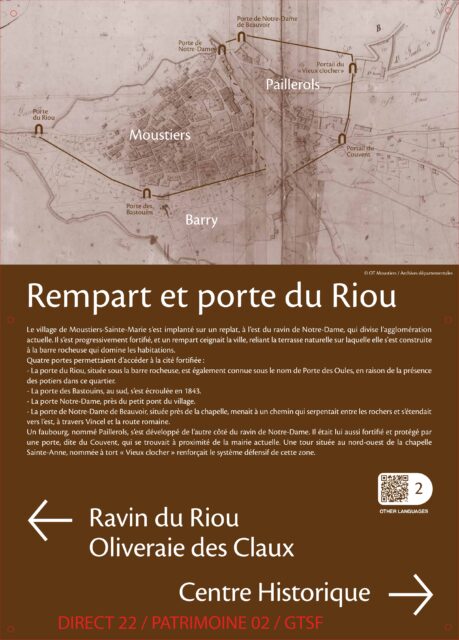
The village of Moustiers-Sainte-Marie was established on a flat area, to the east of the Notre-Dame ravine, which divides the current agglomeration. It was gradually fortified, and a rampart surrounded the city, connecting the natural terrace on which it was built to the rocky bar that dominates the houses.
Four gates provided access to the fortified city:
– The Riou Gate, located under the rocky bar, is also known as the Gate of the Oules, due to the presence of potters in this district.
– The Porte des Bastouins, to the south, collapsed in 1843.
– The Notre-Dame gate, near the small bridge in the village.
– The gate of Notre-Dame de Beauvoir, located near the chapel, led to a path that meandered between the rocks and extended eastwards, through Vincel and the Roman road. A suburb, called Paillerols, has developed on the other side of the ravine of Notre-Dame. It was also fortified and protected by a gate, known as the Convent gate, which was located near the current town hall. A tower located to the north-west of the Sainte-Anne chapel, wrongly named “Old Bell Tower”, reinforced the defensive system of this area.
Fontaine Clérissy (03)
 © OT Moustiers
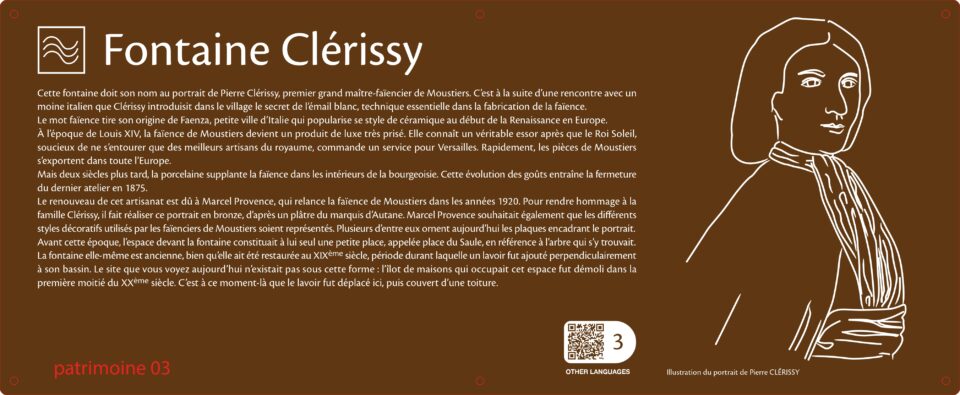
This fountain owes its name to the portrait of Pierre Clérissy, the first great master earthenware maker of Moustiers. It was following a meeting with an Italian monk that Clérissy introduced the secret of white enamel, an essential technique in the manufacture of earthenware, to the village.
The word earthenware originates from Faenza, a small town in Italy that popularized its style of ceramics at the beginning of the Renaissance in Europe. At the time of Louis XIV, Moustiers earthenware became a highly prized luxury product. It experienced a real boom after the Sun King, anxious to surround himself only with the best craftsmen in the kingdom, ordered a service for Versailles. Quickly, Moustiers pieces were exported throughout Europe.
But two centuries later, porcelain supplanted earthenware in the interiors of the bourgeoisie. This change in tastes led to the closure of the last workshop in 1875. The revival of this craft was due to Marcel Provence, who revived Moustiers earthenware in the 1920s. To pay homage to the Clérissy family, he had this bronze portrait made, after a plaster cast of the Marquis d’Autane. Marcel Provence also wanted the different decorative styles used by the earthenware makers of Moustiers to be represented. Several of them now adorn the plaques framing the portrait. Before that time, the space in front of the fountain alone constituted a small square, called Place du Saule, in reference to the tree that was there. The fountain itself is old, although it was restored in the 19th century, during which time a wash house was added perpendicular to its basin. The site you see today did not exist in this form: the block of houses that occupied this space was demolished in the first half of the twentieth century. It was at this time that the washhouse was moved here, then covered with a roof.
Moustiers, a village shaped by water (04)
 © OT Moustiers
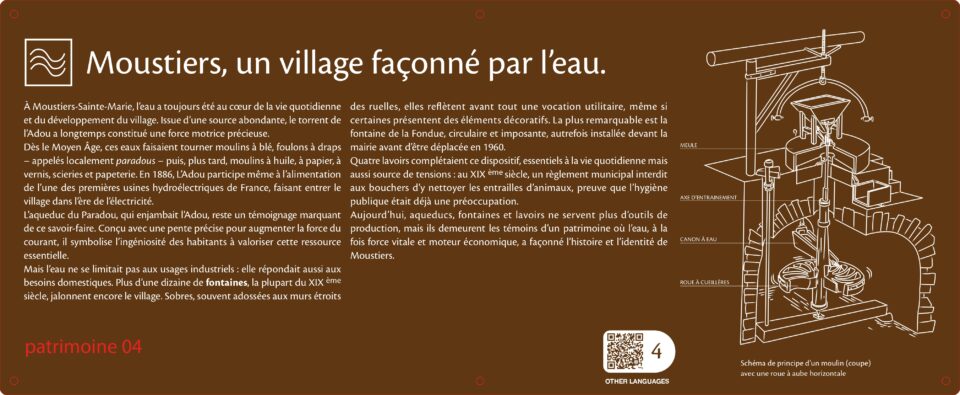
In Moustiers-Sainte-Marie, water has always been at the heart of daily life and the development of the village. Coming from an abundant spring, the Adou torrent has long been a valuable driving force.
As early as the Middle Ages, these waters turned wheat mills, cloth fullers – locally called paradous – and, later, oil mills, paper mills, varnish mills, sawmills and paper mills. In 1886, L’Adou even participated in the supply of one of the first hydroelectric plants in France, bringing the village into the age of electricity.
The Paradou aqueduct, which spanned the Adou, remains a striking testimony to this know-how. Designed with a precise slope to increase the strength of the current, it symbolises the ingenuity of the inhabitants in making the most of this essential resource.
But water was not limited to industrial uses: it also met domestic needs. More than a dozen fountains, most of them from the nineteenth century, still dot the village. Sober, often leaning against the narrow walls of the alleys, they reflect above all a utilitarian vocation, even if some have decorative elements. The most remarkable is the circular and imposing Fondue fountain, once installed in front of the town hall before being moved in 1960. Four washhouses completed this system, essential to daily life but also a source of tension: in the nineteenth century, a municipal by-law forbade butchers to clean animal entrails there, proof that public hygiene was already a concern. Today, aqueducts, fountains and washhouses are no longer used as production tools, but they remain the witnesses of a heritage where water, both a vital force and an economic engine, has shaped the history and identity of Moustiers.
L’Étoile (06)
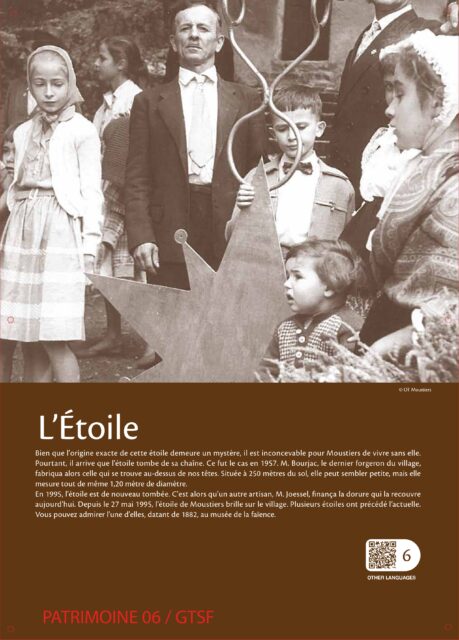
Although the exact origin of this star remains a mystery, it is inconceivable for Moustiers to live without it. However, sometimes the star falls off its chain. This was the case in 1957. Mr. Bourjac, the last blacksmith in the village, then made the one above our heads. Located 250 meters above the ground, it may seem small, but it still measures 1.20 meters in diameter. In 1995, the star fell again. It was then that another craftsman, Mr. Joessel, financed the gilding that covers it today. Since May 27, 1995, the star of Moustiers has shone on the village. Several stars preceded the current one. You can admire one of them, dating from 1882, in the earthenware museum.
 © OT Moustiers
Chapel of Notre-Dame de Beauvoir (07)
 © OT Moustiers
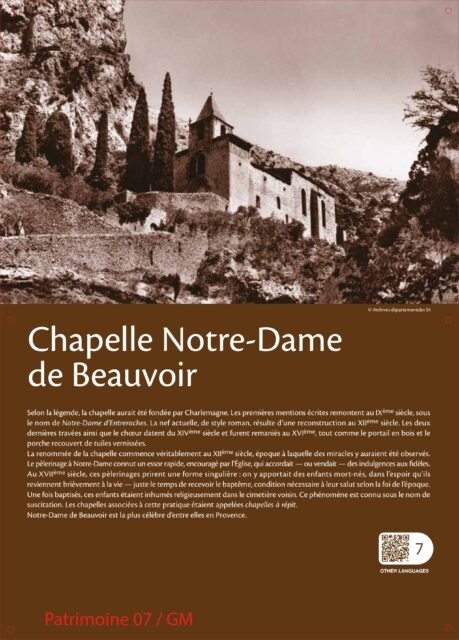
According to legend, the chapel was founded by Charlemagne. The first written mentions date back to the ninth century, under the name of Notre-Dame d’Entreroches. The current nave, in Romanesque style, is the result of a reconstruction in the twelfth century. The last two bays and the chancel date from the 14th century and were redesigned in the 16th century, as were the wooden portal and the porch covered with glazed tiles.
The fame of the chapel really began in the twelfth century, a time when miracles were said to have been observed there. The pilgrimage to Notre-Dame grew rapidly, encouraged by the Church, which granted — or sold — indulgences to the faithful. In the seventeenth century, these pilgrimages took on a singular form: stillborn children were brought there, in the hope that they would come back to life briefly — just long enough to receive baptism, a necessary condition for their salvation according to the faith of the time. Once baptized, these children were buried religiously in the nearby cemetery. This phenomenon is known as arousal. The chapels associated with this practice were called respite chapels. Notre-Dame de Beauvoir is the most famous of them in Provence.
An exceptional natural environment around Moustiers-Sainte-Marie. (08)
 © OT Moustiers
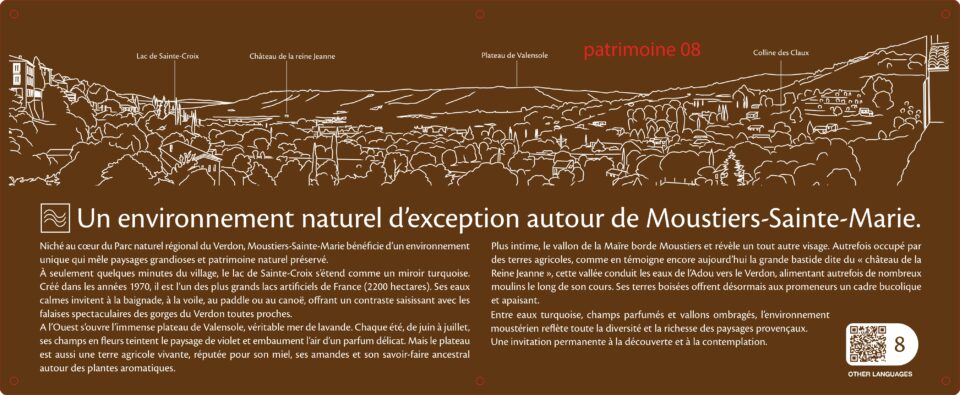
Nestled in the heart of the Verdon Regional Natural Park, Moustiers-Sainte-Marie benefits from a unique environment that combines grandiose landscapes and preserved natural heritage.
Only a few minutes from the village, the lake of Sainte-Croix stretches out like a turquoise mirror. Created in the 1970s, it is one of the largest artificial lakes in France (2200 hectares). Its calm waters invite you to swim, sail, paddle or canoe, offering a striking contrast to the spectacular cliffs of the nearby Verdon Gorges.
To the west opens the immense plateau of Valensole, a veritable sea of lavender. Every summer, from June to July, its flowering fields tint the landscape purple and perfume the air with a delicate fragrance. But the plateau is also a living agricultural land, renowned for its honey, almonds and ancestral know-how around aromatic plants.
More intimate, the Maïre valley borders Moustiers and reveals a completely different face. Formerly occupied by agricultural land, as evidenced today by the large bastide known as the “Château de la Reine Jeanne”, this valley leads the waters of the Adou to the Verdon, once supplying many mills along its course. Its wooded land now offers walkers a bucolic and soothing setting.
Between turquoise waters, fragrant fields and shady valleys, the Mousterian environment reflects all the diversity and richness of the Provençal landscapes. A permanent invitation to discovery and contemplation.
Bouquet of Saint-Eloi (09)
 © Ot Moustiers
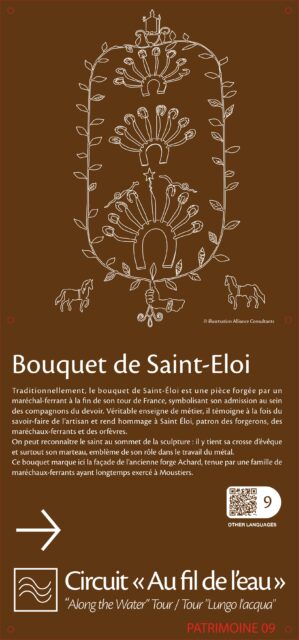
Traditionally, the bouquet of Saint-Éloi is a piece forged by a farrier at the end of his tour of France, symbolizing his admission to the Compagnons du Devoir. A true trade sign, it bears witness to the know-how of the craftsman and pays tribute to Saint Eloi, patron saint of blacksmiths, farriers and goldsmiths. The saint can be recognized at the top of the sculpture: he holds his bishop’s crosier and especially his hammer, emblem of his role in metalwork. This bouquet marks the façade of the former Achard forge, run by a family of farriers who worked for a long time in Moustiers.
Sainte-Madeleine Cave (10)
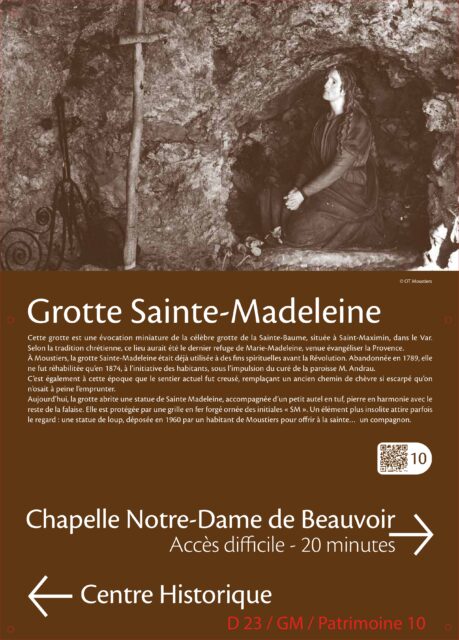
This cave is a miniature evocation of the famous Sainte-Baume cave, located in Saint-Maximin, in the Var.
According to Christian tradition, this place was the last refuge of Mary Magdalene, who came to evangelize Provence. In Moustiers, the Sainte-Madeleine cave was already used for spiritual purposes before the Revolution. Abandoned in 1789, it was only rehabilitated in 1874, on the initiative of the inhabitants, under the impetus of the parish priest Mr. Andrau. It was also at this time that the current path was dug, replacing an old goat path so steep that no one dared to take it.
Today, the cave houses a statue of Saint Magdalene, accompanied by a small altar made of tuff, a stone in harmony with the rest of the cliff. It is protected by a wrought iron gate decorated with the initials “SM”. A more unusual element sometimes catches the eye: a statue of a wolf, placed in 1960 by a resident of Moustiers to offer the saint… a companion.
 © OT Moustiers
The ascent to the chapel (11)
 © OT Moustiers
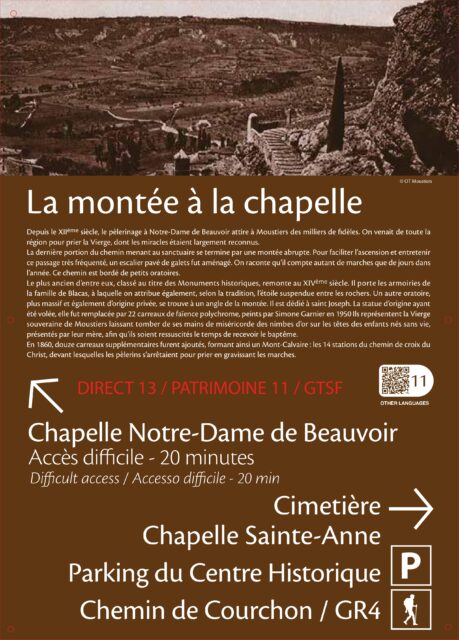
Since the twelfth century, the pilgrimage to Notre-Dame de Beauvoir has attracted thousands of faithful to Moustiers. People came from all over the region to pray to the Virgin, whose miracles were widely recognized. The last portion of the path to the sanctuary ends with a steep climb. To facilitate the ascent and maintain this very busy passage, a staircase paved with pebbles was built. It is said that there are as many walks as there are days in the year. This path is bordered by small oratories.
The oldest of them, classified as a Historic Monument, dates back to the fourteenth century. It bears the coat of arms of the Blacas family, to which the star suspended between the rocks is also attributed, according to tradition. Another oratory, more massive and also of private origin, is located at a corner of the ascent. It is dedicated to Saint Joseph. The original statue having been stolen, it was replaced by 22 polychrome earthenware tiles, painted by Simone Garnier in 1950 They represent the Sovereign Virgin of Moustiers dropping golden nimbus from her hands of mercy on the heads of children born lifeless, presented by their mother, so that they could be resurrected for the time it took to receive baptism.
In 1860, twelve additional tiles were added, forming a Mount Calvary: the 14 stations of the Way of the Cross of Christ, in front of which pilgrims stopped to pray as they climbed the steps.
The “Château”, a building at the heart of the history of Moustiers (12)
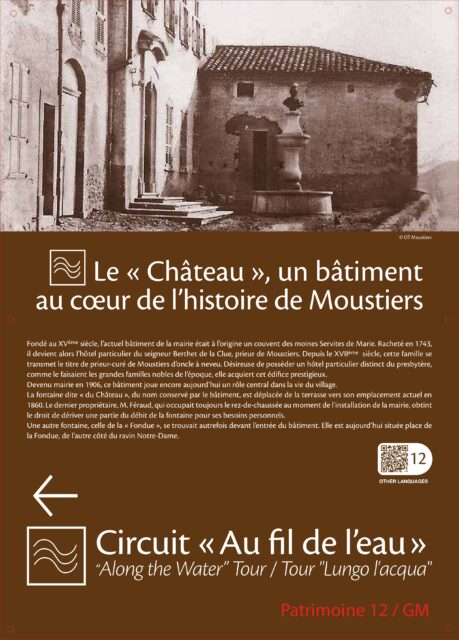
Founded in the fifteenth century, the current town hall building was originally a convent of the Servite monks of Mary. Bought in 1743, it then became the private mansion of Lord Berthet de la Clue, prior of Moustiers. Since the seventeenth century, this family has passed on the title of prior-parish priest of Moustiers from uncle to nephew. Wishing to own a private mansion separate from the presbytery, as the great noble families of the time did, she acquired this prestigious building. This building became the town hall in 1906 and still plays a central role in the life of the village.
The fountain known as the “Castle”, the name kept by the building, was moved from the terrace to its current location in 1860. The last owner, Mr. Féraud, who was still occupying the ground floor at the time of the installation of the town hall, obtained the right to divert part of the flow of the fountain for his personal needs. Another fountain, the “Fondue”, once stood in front of the entrance to the building. It is now located on the Place de la Fondue, on the other side of the Notre-Dame ravine.
 © OT Moustiers
Lavoir de la Bourgade (13)
 © OT Moustiers
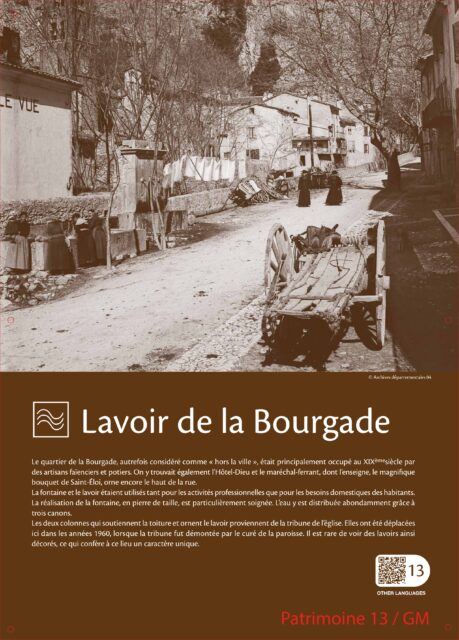
The district of La Bourgade, once considered “outside the city”, was mainly occupied in the nineteenth century by earthenware and pottery craftsmen. There were also the Hôtel-Dieu and the farrier, whose sign, the magnificent bouquet of Saint-Éloi, still adorns the top of the street.
The fountain and the washhouse were used both for professional activities and for the domestic needs of the inhabitants. The fountain, in cut stone, is particularly meticulous. Water was distributed abundantly thanks to three cannons. The two columns that support the roof and adorn the washhouse come from the church gallery. They were moved here in the 1960s, when the gallery was dismantled by the parish priest. It is rare to see washhouses decorated in this way, which gives this place a unique character.
Fountain of the Diana (14)
 © OT Moustiers
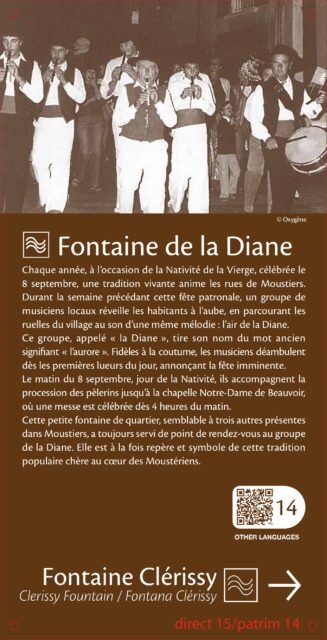
Every year, on the occasion of the Nativity of the Virgin, celebrated on 8 September, a living tradition enlivens the streets of Moustiers. During the week preceding this patron saint’s festival, a group of local musicians wakes up the inhabitants at dawn, walking through the streets of the village to the sound of the same melody: the aria of the Diana. This group, called “the Diana”, takes its name from the ancient word meaning “the dawn”. True to custom, the musicians wander around at the first light of day, announcing the imminent party.
On the morning of September 8, the day of the Nativity, they accompanied the procession of pilgrims to the chapel of Notre-Dame de Beauvoir, where a mass was celebrated at 4 a.m.
This small neighborhood fountain, similar to three others in Moustiers, has always served as a meeting point for the Diana group. It is both a landmark and a symbol of this popular tradition dear to the hearts of the Mousterians.
Hotel Dieu (15)
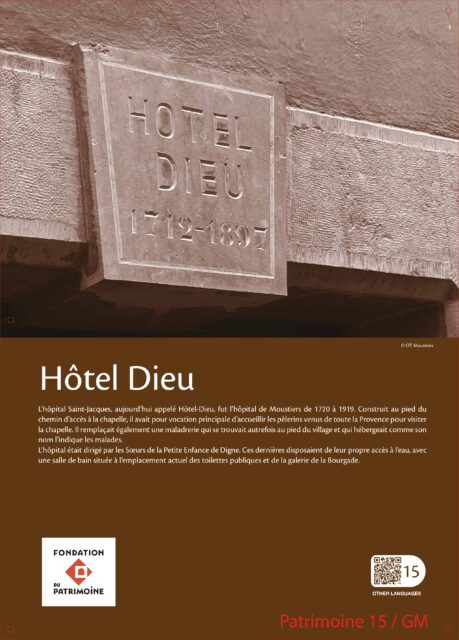
The Saint-Jacques Hospital, now called Hôtel-Dieu, was the hospital of Moustiers from 1720 to 1919. Built at the foot of the access road to the chapel, its main purpose was to welcome pilgrims from all over Provence to visit the chapel. It also replaced a sickhouse that was once located at the foot of the village and which, as its name suggests, housed the sick. The hospital was run by the Sisters of Early Childhood of Digne. The latter had their own access to the water, with a bathroom located on the current site of the public toilets and the gallery of the Bourgade.
 © OT Moustiers
Lavoir de la Source (16)
 © OT Moustiers
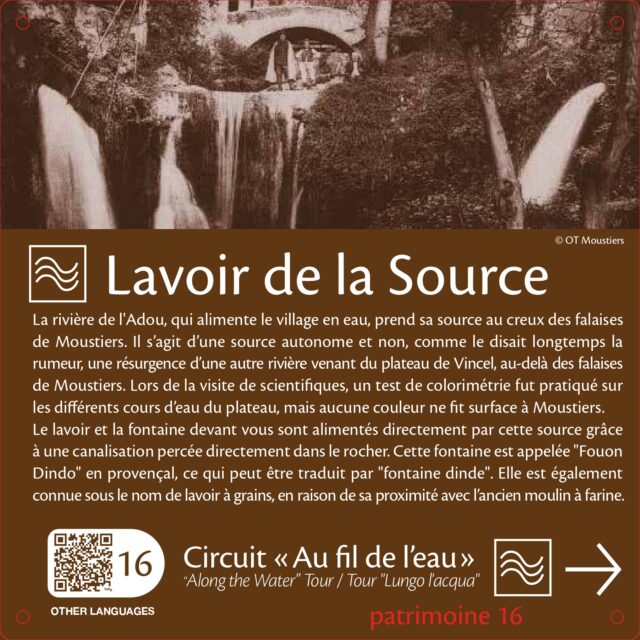
The Adou river, which supplies the village with water, has its source in the hollow of the cliffs of Moustiers. It is an autonomous spring and not, as the rumour had long said, a resurgence of another river coming from the Vincel plateau, beyond the cliffs of Moustiers. During the visit of scientists, a colorimetry test was carried out on the different rivers of the plateau, but no color surfaced in Moustiers. The wash house and the fountain in front of you are fed directly by this spring thanks to a pipe drilled directly into the rock. This fountain is called “Fouon Dindo” in Provençal, which can be translated as “turkey fountain”. It is also known as the grain washhouse, due to its proximity to the old flour mill.
Atelier Saint François (17)
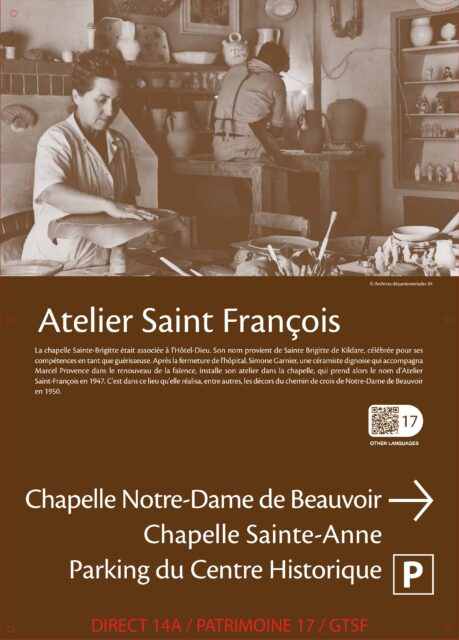
The Sainte-Brigitte chapel was associated with the Hôtel-Dieu. Its name comes from Saint Bridget of Kildare, celebrated for her skills as a healer. After the hospital closed, Simone Garnier, a ceramist from Digne who accompanied Marcel Provence in the revival of earthenware, set up her workshop in the chapel, which then took the name of Atelier Saint-François in 1947. It was in this place that she created, among other things, the decorations of the Stations of the Cross of Notre-Dame de Beauvoir in 1950.
 © OT Moustiers
Legend of the Knight Blacas (18)
 © OT Moustiers
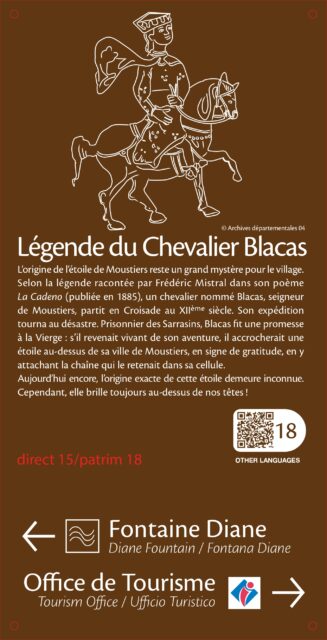
The origin of the star of Moustiers remains a great mystery for the village. According to the legend told by Frédéric Mistral in his poem La Cadeno (published in 1885), a knight named Blacas, lord of Moustiers, left on a Crusade in the twelfth century. His expedition turned into a disaster. A prisoner of the Saracens, Blacas made a promise to the Virgin: if he returned alive from his adventure, he would hang a star above his town of Moustiers, as a sign of gratitude, by attaching to it the chain that held him in his cell. Even today, the exact origin of this star remains unknown. However, it still shines above our heads!
L’Apier (19)
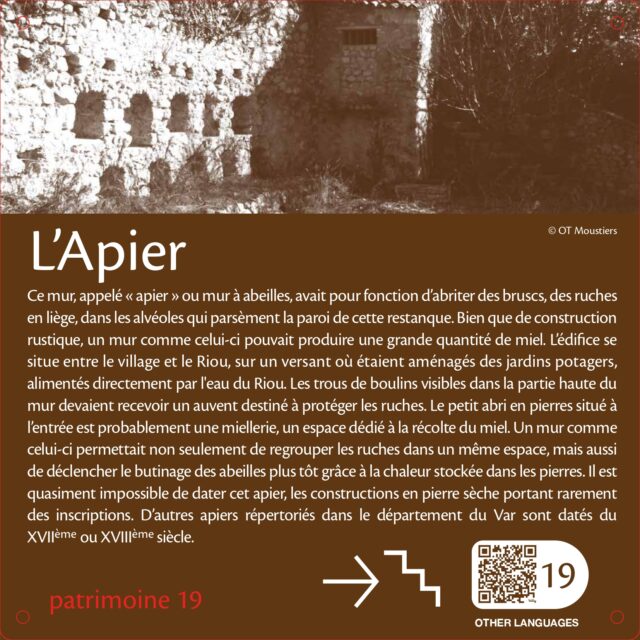
This wall, called “apier” or bee wall, had the function of sheltering bruscs, cork hives, in the cells that dot the wall of this terrace. Although of rustic construction, a wall like this could produce a large quantity of honey. The building is located between the village and the Riou, on a slope where vegetable gardens were laid out, fed directly by the water of the Riou. The bolt holes visible in the upper part of the wall must have been fitted with a canopy to protect the hives. The small stone shelter located at the entrance is probably a honey house, a space dedicated to the harvesting of honey. A wall like this not only made it possible to group the hives in the same space, but also to trigger the bees’ foraging earlier thanks to the heat stored in the stones. It is almost impossible to date this apier, as dry stone constructions rarely bear inscriptions. Other apiers listed in the Var department are dated to the seventeenth or eighteenth century.
 © OT Moustiers
Sainte-Anne Chapel (20)*
 © OT Moustiers
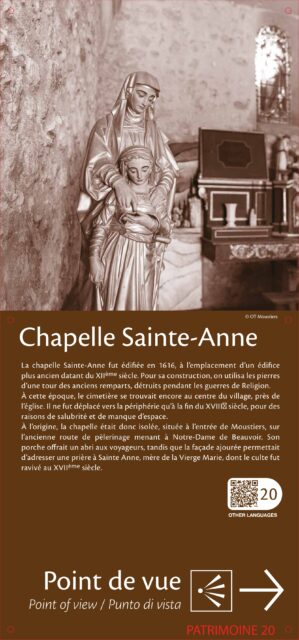
The Sainte-Anne chapel was built in 1616, on the site of an older building dating from the twelfth century. For its construction, the stones of a tower of the old ramparts, destroyed during the Wars of Religion, were used. At that time, the cemetery was still located in the centre of the village, near the church. It was only moved to the outskirts at the end of the XVIII_ century, for reasons of health and lack of space. Originally, the chapel was therefore isolated, located at the entrance to Moustiers, on the old pilgrimage route leading to Notre-Dame de Beauvoir. Its porch offered shelter to travellers, while the openwork façade made it possible to address a prayer to Saint Anne, mother of the Virgin Mary, whose cult was revived in the seventeenth century.